Nyhed
Huge waste in the construction industry
Lagt online: 07.01.2026
Nyhed
Huge waste in the construction industry
Lagt online: 07.01.2026
Huge waste in the construction industry
Nyhed
Lagt online: 07.01.2026
Nyhed
Lagt online: 07.01.2026
By Simon Danneskiold-Samsøe, AAU Communication and Public Affairs Photo: Colourbox
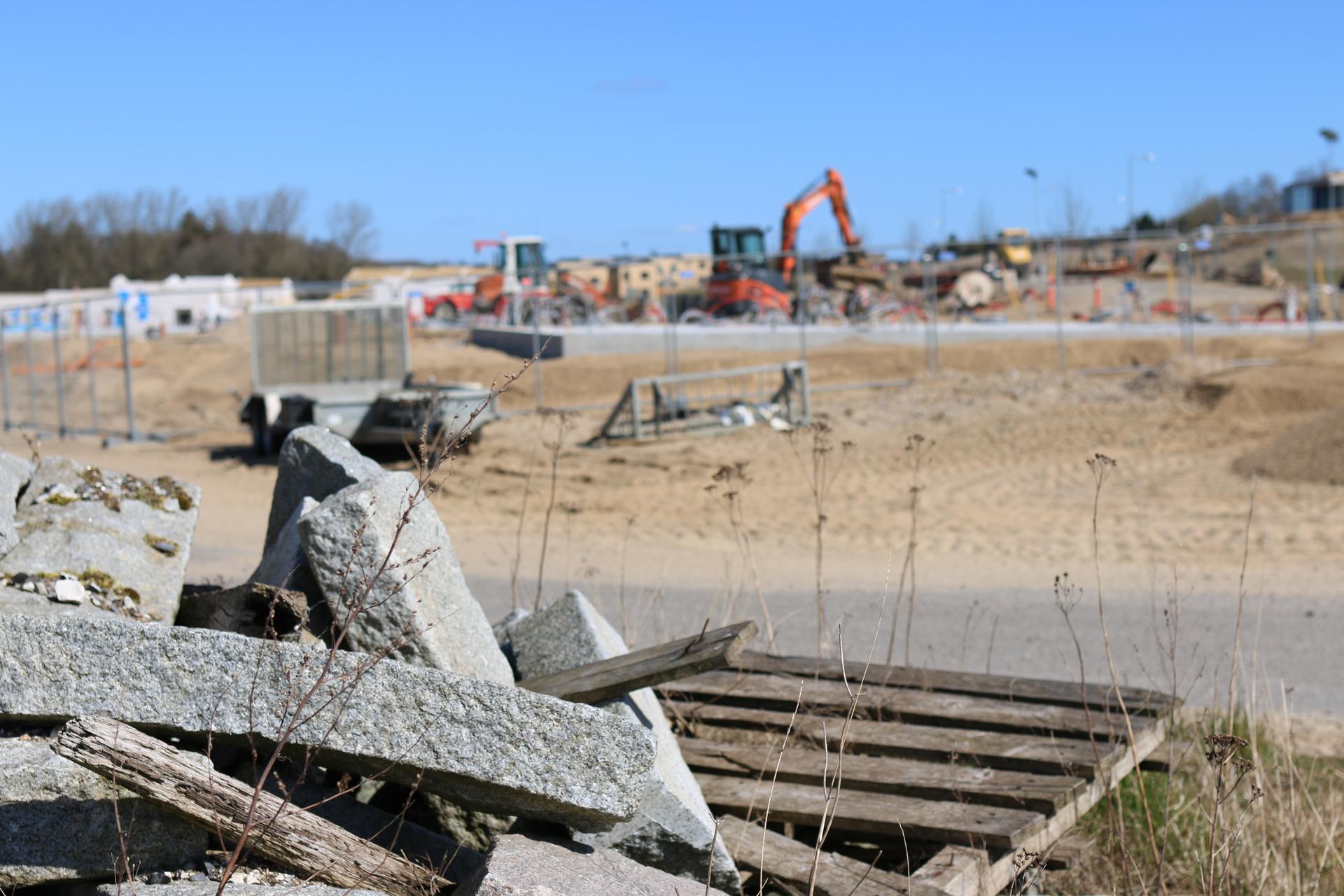
Excavators and cranes are rumbling out there, and the Danish construction industry is busy. So busy, in fact, that huge amounts of building material are wasted daily. A new research article from Aalborg University shows that for some groups of materials up to a quarter of the amount supplied ends up in a waste container.
This applies particularly to cut-to-size materials like roofing felt, reinforcing bars, plaster and insulation, and the packaging that the materials are delivered in or on also makes up an unnecessarily large part of the material wasted. In fact, up to 28 percent of the climate impact from waste on the construction site can be attributed to packaging, primarily wooden pallets and plastic film.
The research shows that in general, between three and 30 percent of the amount of material supplied is wasted, including packaging. These large quantities cost contractors money in procurement and disposal, and the waste treatment emits an unnecessary amount of CO2.
In fact, we can cut more than 50 percent of emissions from construction waste, corresponding to about 10 percent of the total CO2 emissions for new construction, if active efforts are made to reduce waste percentages.
- I was surprised at how high the waste percentages are, especially for materials like mortar, plaster and insulation. This is not only an economic problem, but also a major climate challenge. Of course, no one has an interest in throwing away usable materials, but in a busy industry, it happens every day. We therefore need to consider the expected material waste in the planning phase, because a lot of the waste can be avoided or reused, says Lea Hasselsteen, author and PhD student, Department of the Built Environment, AAU.
The research project investigated material waste on 26 Danish construction projects and developed a method that makes it possible to predict waste volumes and climate impact early in the process. The study introduces a new prediction model that links material use with life cycle assessment (LCA) so that builders, consultants and contractors can estimate waste volumes and CO₂ footprints early on in the planning phase.
The model underpins new goals that will help the industry reduce waste and promote circular economy. The research article is thus also a definite tool that the construction industry can use to minimize waste.
- Some of the solutions are as simple as looking at the dimensions of the available materials before finalizing the drawings for the building. Take plasterboard, for example, where there is often substantial waste because this is cut to the individual rooms. If the architecture, panel dimensions and purchasing match from the start, nothing needs to go to waste. It was important for me to build a bridge between the academic work and the practical solutions, so that it is possible for contractors to react proactively, rather than just documenting afterwards, says Lea Hasselsteen.
The study applies the prediction model to data from 309 Danish construction projects since 2007 and the results estimate both waste volumes and climate impact that can be used early in the planning phase.
The article is thus also a practical tool that translates complex calculations into a concrete decision-making basis for the industry.
Read the full article here.
Lea Hasselsteen, PhD student, Department of the Built Environment, AAU, leahn@build.aau.dk, tel.: +45 2270 9624
Simon Danneskiold-Samsøe, Journalist, AAU, ssd@adm.aau.dk, tel.: +45 3115 7533
Translated by LeeAnn Iovanni, AAU Communication and Public Affairs