Nyhed
Time to Say Goodbye to the Single-Family House
Lagt online: 09.01.2025
Nyhed
Time to Say Goodbye to the Single-Family House
Lagt online: 09.01.2025
Time to Say Goodbye to the Single-Family House
Nyhed
Lagt online: 09.01.2025
Nyhed
Lagt online: 09.01.2025
By David Graff, AAU Communication and Public Affairs
Photo: Kenneth Bagge Jørgensen/Colourbox
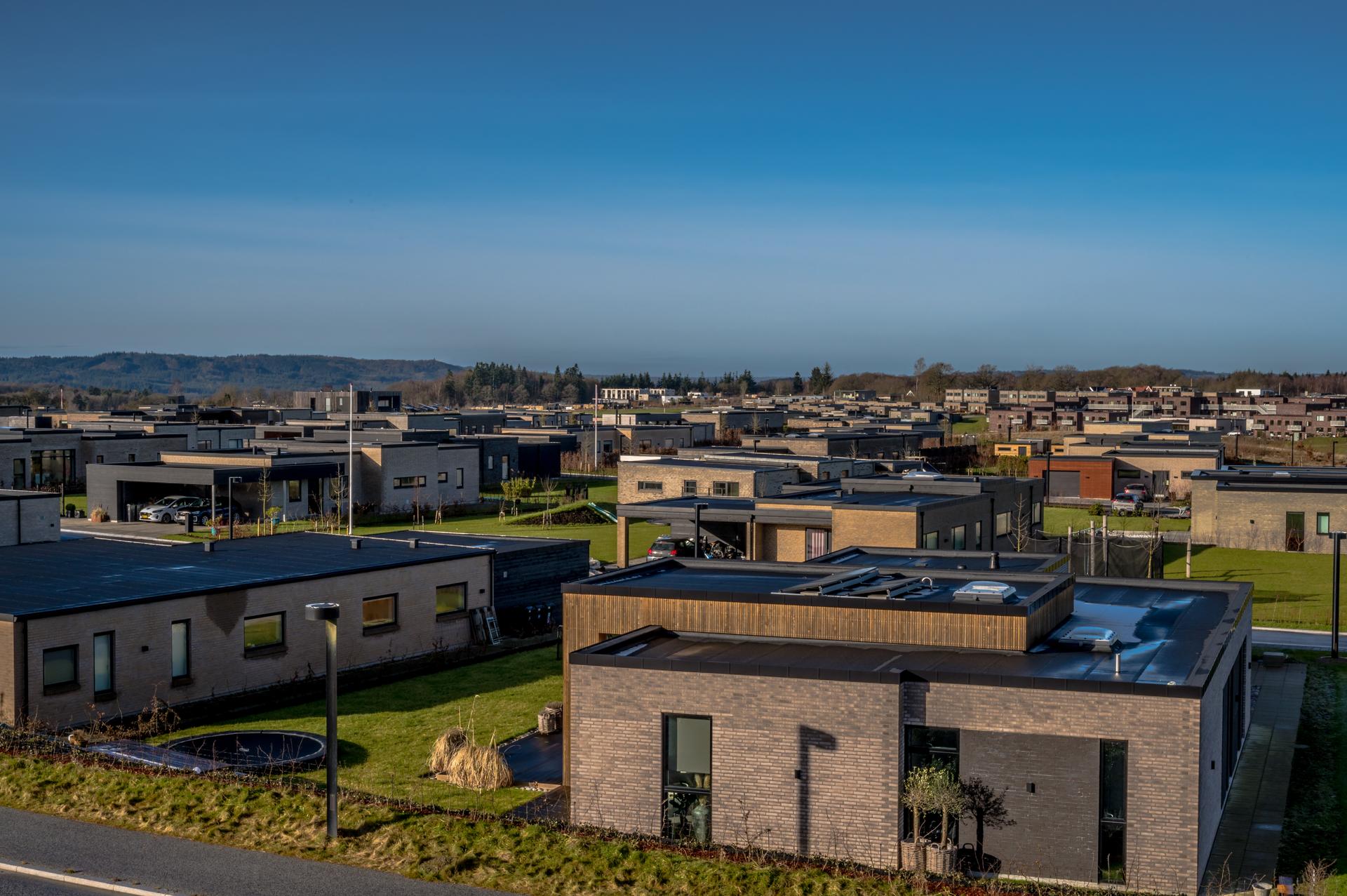
In Denmark, we demolish around 1,100 houses every year. That corresponds to a small town disappearing annually. At the same time, the size of the new houses we build continues to grow. On average, single-family houses have increased from approx. 130 m² in the 1970s to 180 m² today.
“We love our single-family houses. We live in them for many years, and their size has grown over time. And when the old house no longer matches our housing dreams, we tear it down and build a new one. The consequence is overconsumption, and that is bad news for the green transition,” explains senior researcher Mette Mechlenborg from BUILD – Department of the Built Environment.
In other words, fewer and fewer people live on more and more space. Space that must be heated, cooled, ventilated, and lit — and filled with all kinds of energy‑consuming equipment: floor‑to‑ceiling windows, smart lighting systems, huge fridge‑freezers, and so on.
One might think that Danes’ energy consumption in single-family houses has decreased over recent decades, given the rapid technological development aimed at saving energy. But it hasn’t — because we have simply filled our homes with more and more items. Even though each item is energy‑efficient, the sheer number of them means that the total energy consumption does not decrease.
“We’re in the middle of a consumption party that must stop, because the party harms the climate,” says Mette Mechlenborg.
During the Christmas holidays, she published an op-ed in JyllandsPosten titled ’Danes love their single-family house. But times are changing’. It was no coincidence that the op‑ed appeared in a newspaper with many readers.
“The recipients of my message are first and foremost Danes. Because it is the housing ideals and dreams we each carry — and which shape our individual and societal ideas of the good life — that need to be addressed,” she points out.
Mette Mechlenborg believes that our housing dreams are so deeply rooted that it will be difficult to change them without help from municipalities and politicians to see single-family houses in a new light.
“For most people, the home is a mirror of personal values and dreams, and a display window to the world. Therefore, housing choices are both rational and irrational, based on identity and social positioning — and not least on societal expectations.”
Although she sees signs that our preference for the single-family house is changing — for example, micro‑homes are becoming more popular — it does not change the fact that single-family houses remain extremely dominant as our preferred housing type. She believes a different approach from municipalities and politicians is needed to shift the picture.
“For example, it should be harder to get permission to demolish and rebuild. In addition, it may make sense to develop incentives that encourage us to adapt our housing choices to different life phases and get used to the idea that bigger is not always better,” says Mette Mechlenborg.
Originally, the single-family house was designed for the nuclear family — two adults with children. But families with children are now in the minority in single-family neighbourhoods, where the resident composition is far more diverse: singles, seniors, blended families, and many of the 37 family types identified by Statistics Denmark.
“Our relationship with our house and garden is long and enduring — significantly longer than the roughly 11 years a marriage lasts on average. But even the best marriage can benefit from a check‑up, and much has changed in our culture, demographics, family patterns, and working life since the baby boomers moved to the suburbs and planted the first privet hedges,” says Mette Mechlenborg.
She points out that the single-family house is now the most preferred type of senior housing: 40% of all single-family houses in Denmark are inhabited by so‑called empty nesters — older adults without children living at home.
This means that many people live in a housing type that no longer matches their actual housing needs. And this contributes to the single-family house having the highest floor‑area consumption per resident across all housing types in Denmark. On average, each person in a single-family house has 62 m² to themselves.
Mette Mechlenborg has the following suggestions for how we can curb the trend toward more and more — and larger and larger — single‑family houses.
Municipalities should be able to reward renovation
Municipalities should have the option to deny demolition and instead reward renovation.
Make smaller homes attractive for families
Incentives should be developed to make it attractive to move from single-family houses into smaller homes once children have moved out.
Make room for more families in one house
Rules should be changed to make it easier to divide existing houses so that more families can live in the same space.
Danes’ single-family houses