Nyhed
Denmark’s first shared LCA tool to boost green transition in urban spaces and landscapes
Lagt online: 09.11.2025
Nyhed
Denmark’s first shared LCA tool to boost green transition in urban spaces and landscapes
Lagt online: 09.11.2025
Denmark’s First Shared LCA Tool to Accelerate the Green Transition in Urban Spaces and Landscapes
Nyhed
Lagt online: 09.11.2025
Nyhed
Lagt online: 09.11.2025
By Thomas Møller Christensen, AAU Communication and Public Affairs
Photo: Jens Hasse/Chili and Colourbox
How can we create cities that not only reduce emissions but also actively store carbon?
That question lies at the heart of LCAlandskab, a new research and development project launched by BUILD in collaboration with landscape architecture firm SLA and consultancy Aaen Engineering. The initiative is supported by several foundations and associations, including the philanthropic association Realdania.
LCA (Life Cycle Assessment) is a method used to document climate and environmental impacts throughout the entire lifecycle of a project. It is widely applied in the construction industry to assess the climate footprint of buildings and infrastructure.
However, until now, there has been no validated method for calculating the climate footprint of parks, urban spaces, or green infrastructure.
LCAlandskab will be the first open-source tool to bring together data, expertise, and experience from across the industry, offering a unified and transparent approach to measuring sustainability in urban landscapes.
“Knowledge is the first step toward action. The green transition is the most important challenge of our time, and that’s why we need to understand what works and what doesn’t. With LCAlandskab, we can design cities that both minimize their footprint and absorb CO2, while becoming more resilient to climate change,” says Harpa Birgisdóttir, Professor at BUILD and one of the key figures behind the well-known LCAbyg tool used in the building sector.
LCAlandskab is designed to support the design process, help create low-impact cities, and give decision-makers a validated foundation for future planning.
“Our cities are constantly evolving to meet new needs, not only in buildings and infrastructure but also in green and shared spaces. That’s why decisions must be based on knowledge about the full lifecycle and long-term impacts. A shared calculation tool will be an important step in that direction,” says Mikkel Suell Henriques, Project Director at Realdania.
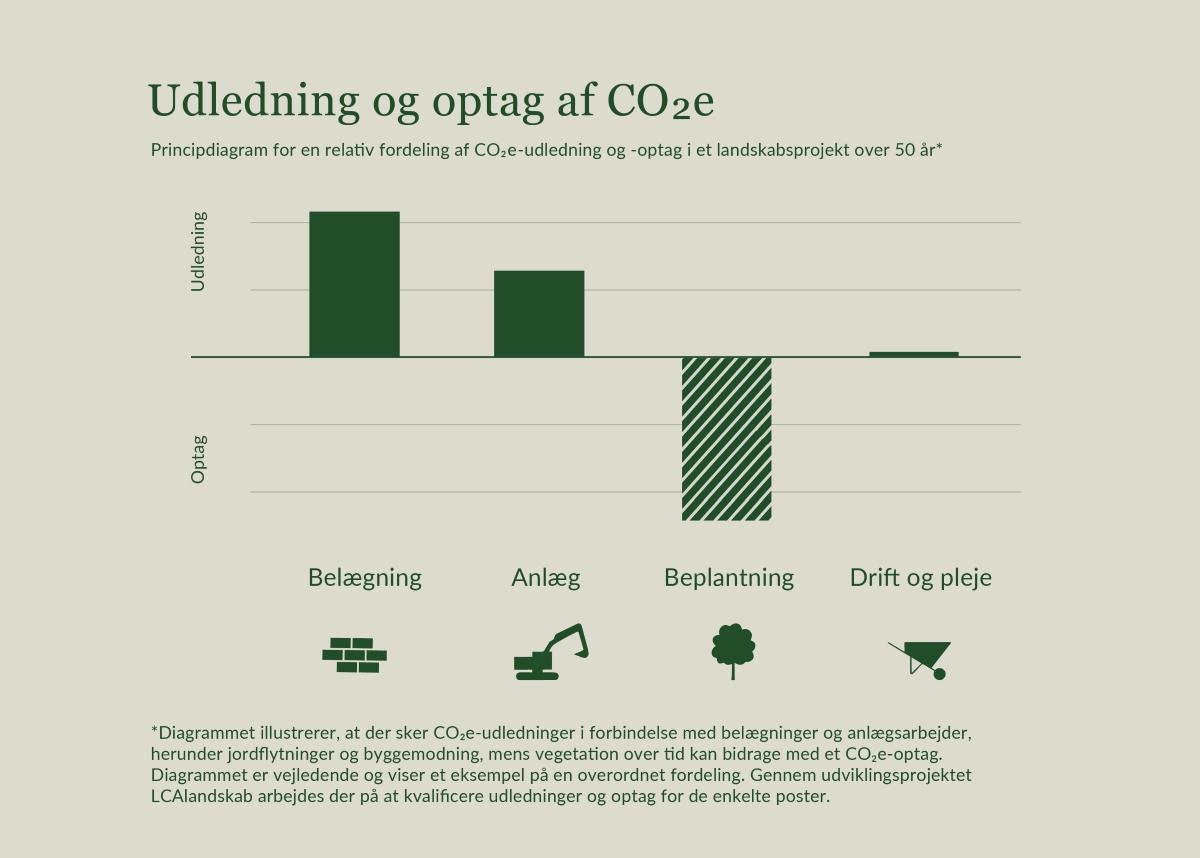
A key focus of the project is to quantify both emissions and carbon uptake related to the construction and maintenance of urban spaces and green areas. The tool will also highlight the climate potential of vegetation - an area that has been underexplored in traditional climate accounting.
“The construction sector accounts for a large share of Denmark’s CO2 emissions. That makes it crucial to look not only at the footprint of buildings but also at the emissions linked to the development of urban spaces. Every emission counts,” says Micki Aaen, CEO of Aaen Engineering.
Project Overview
The project runs from September 2025 to September 2027 and is carried out in collaboration between BUILD, SLA, and Aaen Engineering, with participation from, among others, the Danish Technological Institute, University of Copenhagen, Kildedal P/S, Gottlieb Paludan Architects, and idverde. The project also includes a stakeholder group made up of partners who wish to follow and contribute to the development.
The project is supported by Realdania, Grundejernes Investeringsfond, and Dreyers Fond, and co-financed by the participating partners.